



What if I told you that everything your parents told you about talent and effort being the keys to success, was a lie? We were raised to believe that if you are smart and worked hard, that you would be rewarded. Think about the people that you know that are “successful” by the world’s standards. Are they the most gifted and hard-working people you know? Or are they the ones who made the boldest choices. The saying isn’t “Fortune favors those who play it safe” for a reason. Those who are compliant, wait for permission, or color within the lines, can only go so far. But those who have agency and choose to walk through doors with no guarantees on the other side, are the ones who are the most wildly successful. The ones who left the safe job to start a huge company. The ones who quit the firm to raise their own funds. The ones who weren’t going to make partner that created their own partnership. Sometimes “better safe than sorry” just leads to a life of regret, because you only had one hand to play and you folded instead of making bets on yourself.
The problem is that not all doors are created equal. You can have all the confidence and audacity in the world, but no doors to walk through. Without access to the right doors, you can’t go anywhere.
Effort ≠ Agency
Many of us grew up with a one-variable theory of success. Study hard. Get good grades and work hard. The work will speak for itself. We were sold a reality based on meritocracy. Unfortunately, that’s not how the real world actually works. We all know people who work their tails off, but never get any recognition for it. Their reward is more work.
Our immigrant parents crossed oceans with almost nothing, and effort was the one thing that no one could take from them. Amidst all the uncertainty, effort was something in their control. Effort was dignity. Effort was survival.
But effort and agency are not the same thing.
Effort is executing the path you were given. Agency is deciding which path to take and sometimes forging one that didn’t exist before.
Effort is doing the assignment better than anyone else. Agency is asking why you are doing the assignment in the first place and coming up with a better way.
You can be the hardest working person in the building and have little to no agency. This describes many of the Asian American workers inside investment banks, law firms, research labs, tech companies and more. We optimize brilliantly inside systems we never question. We assume someone will notice us for our effort and pick us, but we are disappointed when it never happens.
This is the Bamboo Ceiling. It isn’t only a ceiling built by others, part of it is a ceiling we place on ourselves. We are raised to believe that asking for something we deserve, self-promotion, and stepping outside the lines is somehow inappropriate or unearned. We see others as arrogant instead of having agency.
Agency is the willingness to act on the world rather than wait for it. When you are raised to play by the rules, you don’t act unless you’re given permission. Agency means giving yourself permission. Writing the cold email, making the pitch or ask, taking what is in front of you, starting something even when you’re not “qualified”.
Psychologist Julian B. Rotter coined the term locus of control to measure whether a person believes life outcomes crom from their own actions or from external forces. It is largely learned through parenting styles, childhood experiences and past rewards and punishments, rather than being a fixed trait. The external locus can shift to an internal one over time through cognitive reframing.
Shifting your locus of control is often tied to self-efficacy, an individual’s believe in their capacity to execute the behaviors and skills needed to achieve specific goals and perform. Self-efficacy is part of psychologist Albert Bandura’s social cognitive theory. Unlike general self-confidence, self-efficacy is domain and situation dependent. People with strong self-efficacy view difficult tasks as challenges to master rather than threats to avoid. They set higher goals, invest more effort, and recover quickly from failures.
The finding from both psychologists is consistent: people who believe their actions shape outcomes take more swings, and more swings is how outcomes get shaped.
Outcomes ≈ Agency x Access
Not plus. Times.
In order to have successful outcomes, you need both agency and access. A zero is in either one results in no good outcome. The most driven person alive, standing in a room with no doors, goes nowhere. The most well-connected person in the world, unwilling to walk through the doors in front of them, also goes nowhere.
Access is the door. Agency is the hand you use to push the door open. Access is the rooms you can get into, the people who will take your call, the capital you can raise, the deals you can invest in, the conversations that you are a part of, the information you are privy to that others aren’t.
No one likes to admit that access is a variable, because doing so means the game is rigged. But the blunt reality is that the game is not fair, never was and never will be. The data proves it.
When economist Raj Chetty and his colleagues traced the backgrounds of more than a million American inventors, they found that kids born into the top 1% of the income distribution were roughly ten times more likely to become inventors than kids from families below the median. Childhood math scores explained only a small part of that gap. High-scoring kids from lower-income homes simply didn’t become inventors at the same rate. Chetty called them “Lost Einsteins.”
It wasn’t about the money, it was about the exposure. Children who grew up around inventors were far more likely to invent, usually in the same field as the inventors they were exposed to. Girls who grew up in places with more women inventors were more likely to become inventors themselves. The data reinforces that you have to see it to be it.
Four Different Lives
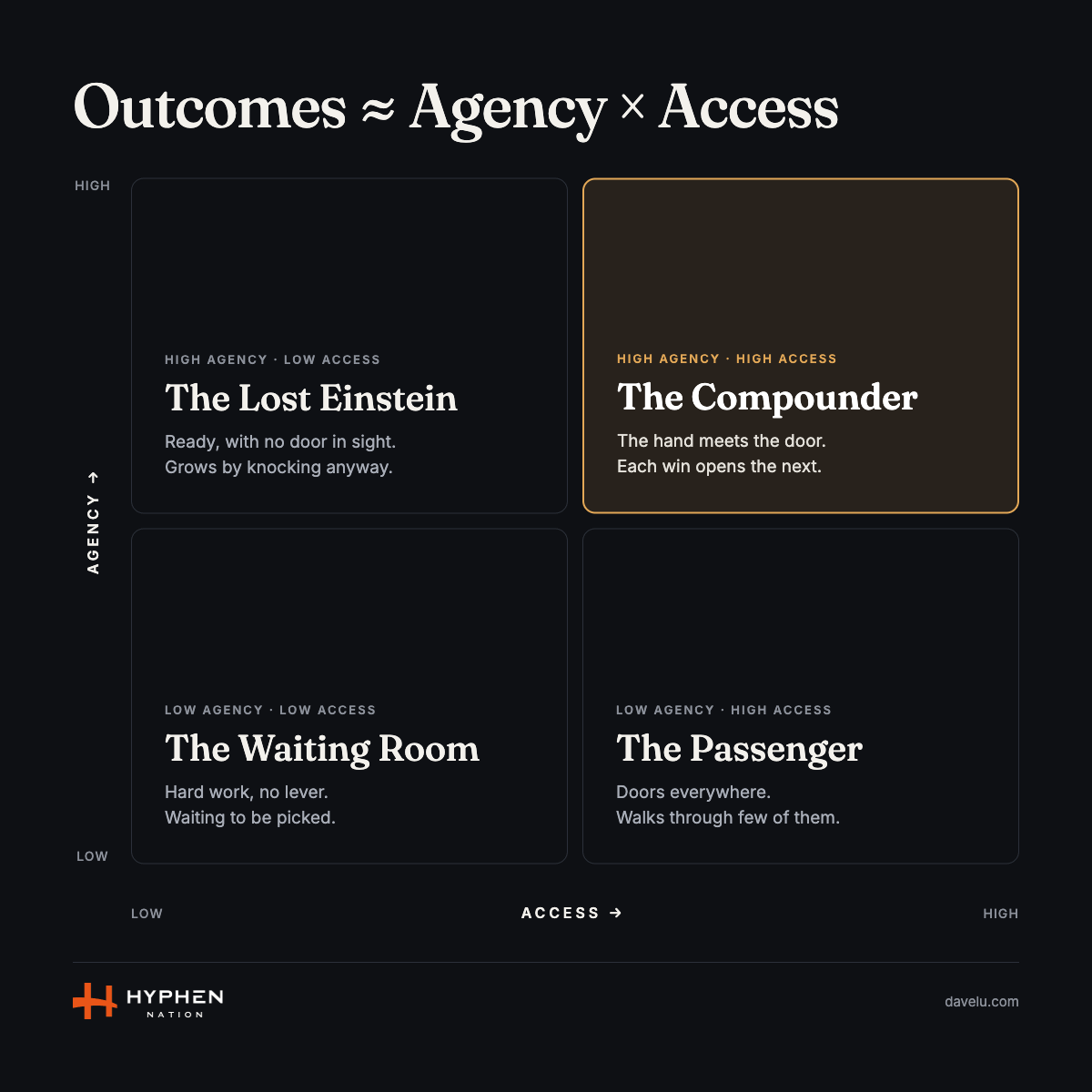
People in The Waiting Room are working hard but going nowhere because they have no leverage. Think about the immigrant kid who has great grades, but is afraid to take any chances because his parents raised him to play it safe and he has no connections to help him. The Lost Einsteins have all the hustle and potential, just none of the opportunities. In a just world with equitable systems, they would have the access to succeed.
Most of the people reading this have worked hard all their lives to get to where they are. You built the perfect resume. You studied hard to get into the right schools. You got hired at the right firms and companies. You are in the rooms where you have access, but you feel stuck. You are The Passenger because you have no agency to open the doors to the next level. You are afraid of taking a risk or making a mistake at your job, so you settle and tell yourself you are satisfied. The Passenger isn’t just the nepo baby who has never had to ask for anything and just wastes all of their privilege. It is also the person who has earned that privilege, but has done nothing with it.
The Compounder is the one who takes the initiative to open the doors that are available to them, which leads to another room with new doors for them to walk through. The two variables of access and agency aren’t independent, each one feeds the other.
The Flywheel
Agency creates access. In 2011, I started the Asian American Founders Circle because there was a vacuum that needed to be filled for such a community. That community of 400+ founders is why I started the Hyphen Capital angel investing syndicate which has since invested over $30 million in over 100 startups. That community of founders and investors have given me outsized access to opportunities beyond anything I could have imagined. They signed the open letter in the Wall Street Journal we wrote condemning anti-Asian hate. That effort led to the community growing even bigger which allowed me to finance the Jeremy Lin documentary 38 at the Garden which won an Emmy Award. That film opened even more doors for me in Hollywood to work on other projects. The angel syndicate opened the door for me to raise an institutional fund. Every door I walked through, led me to more doors.
Access creates agency. As I walked through each door, running a startup, building a community, writing the open letter, producing the film, my sense of what was possible reset. It made me realize that I didn’t need to ask for permission anymore. It recalibrated my reality of what I could do and how many doors I could walk through. The more I accomplished, the more impact I wanted to make.
A little agency can get you more access. That access shows you more doors and raises your ceiling. That higher ceiling gives you more agency. And the compounding flywheel starts turning and turning. Agency and access aren’t additive, they’re multiplicative. Two people who start at the same place at 25 can be in completely different universes by 45, not because one worked harder, but because one got the flywheel spinning and the other was still waiting for permission or hoping to be picked.
The flywheel also works in reverse. If you wait too long to be chosen and you see fewer examples, you take fewer swings and get fewer invitations. Eventually you start to believe that’s just who you are.
The Hamster Wheel
Life can often feel more like a hamster wheel than a flywheel. You’re in the middle of your career. You are busy and your calendar is always booked solid. You are running hard, and the wheel is spinning smoothly. But the view hasn’t changed in five years and you realize you’ve been making no progress.
The cruel part is that the wheel feels like agency. You are making decisions all day: approving, prioritizing, unblocking. But they’re all decisions made within someone else’s flywheel. The person who designed your hamster wheel had the agency to get to where you want to be and you probably helped them get there. Being stuck in the middle where inertia is strongest can be the most self-deceptive place to be.
Agency erodes. You got promoted early on because you were rewarded for good\ execution. But then you stopped taking risks or making scary asks, because the role didn’t ask you to. You never took the initiative to take on the demands of the promotion you wanted. And you also were too afraid to leave the job that never valued you enough in the first place.
Access narrows. Your network becomes limited to your org chart. Your relationships turn into strong ties to the same 40 people for a decade. You get comfortable and stagnant. Chetty’s exposure effect works in reverse: When you stop seeing people like you do something different, you stop imagining it for yourself. You never continued building new connections and the weak ties that matter. If you aren’t surrounding yourself with new people that inspire and push you, it becomes hard to grow.
I’ve written about Anchors and Sails in the past. Once the anchors set in: the comfortable salary, the vesting schedule, the title your parents can brag to their friends about. Individually they are not traps, but combined they make the hamster wheel feel like the safest place in the world.
Ask yourself these questions:
Could you describe the next three years of your job in detail, and does that bore you?
When did you last make an ask that scared you?
How many people outside your company would take your call this week?
If you were offered your current role today, would you take it?
Inertia doesn’t change unless you apply an external force to it. It doesn’t have to be dramatic. Small pushes, applied consistently, can create momentum and change direction. Taking on a project that no one assigned you. Making one new ask per week. Meeting someone new outside your existing circle each day.
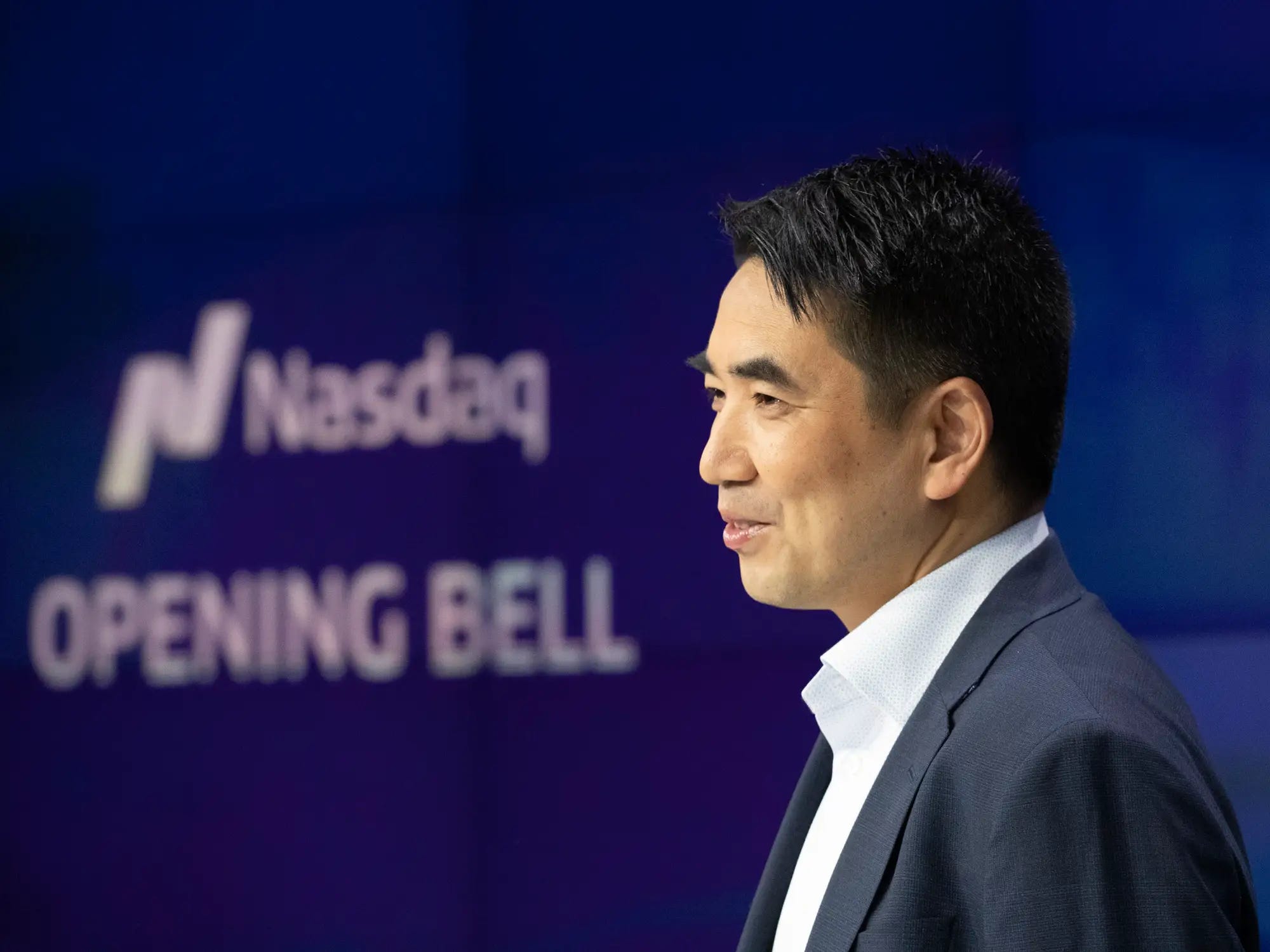
Eric Yuan spent fourteen years on that wheel. He was rejected for a U.S. visa eight times before finally arriving in 1997 to join a young startup called WebEx. By the time Cisco bought it, he was VP of Engineering, a model middle-of-the-org success. He kept telling leadership the product needed to be rebuilt from scratch. They kept passing.
So at 41, he stepped off the wheel to start a new company. Many of WebEx’s best engineers followed him. Subrah Iyar, a WebEx co-founder and former CEO, became an angel investor. The company he started is Zoom.
Eric had been building access the entire time: the team, the relationships, the reputation. He just had to stop running in place to use it. That agency combined with his access compounded to build a multi-billion dollar software business used by hundreds of millions of people around the world every single day.