



What holds people back is not the fear of not having enough, but believing that they themselves are not enough.
Most people live a linear life: They go to college, get a job or go to graduate school, work hard to get a promotion, save up for vacations, and repeat until they retire. Every step is predictable and safe. This is why so many immigrant parents push their children to get into the best college, because it puts them on track for the highest potential salary. The higher the salary, the more financially secure and stable their lives will be. All these tracks are linear. You take one step after another in a straight line to get to your final destination: death.
I’ve often equated this linear life to playing Super Mario Bros, an old Nintendo game where there is only one way to complete the game. Like most linear games, you sidescroll through level after level beating bosses to get to Bowser, the final boss, to save the Princess. There are no shortcuts and you can’t deviate from the path, because it was designed that way.
In terms of the real world, this is like becoming a doctor. You go to college, you take your pre-med requirements and MCATs, you go to medical school, you get matched into residency, you might do a fellowship to specialize, you get hired at a hospital or private practice. You are literally on a track your entire career. It is quite possibly the most meritocratic career you can choose, because your scores and performance get you to the next level. Your MCATs, your medical boards, your medical licensing exams are all the bosses you have to beat to progress in the linear game of medicine.
In contrast, Grand Theft Auto is a game with an open world. You can freely choose where you want to go and what missions you want to complete. You can also choose not to participate in missions and skip them. You can literally win the game and not finish every mission, which is very different from Super Mario Bros., where you can’t progress without finishing each level.
Growing up, I was raised to believe that I couldn’t skip levels. I was told that I have to go to an Ivy League school, get a prestigious internship, get an MBA from Stanford or Harvard, and work to become a VP at a big company, before I could even consider starting my own company. This was all a lie. I could have started a company out of high school, but instead I chose to follow the linear track that was laid out before me. I was told I needed to pay my dues and get years of experience before I could pursue my dreams.
The Chef
Many young chefs that were told that they had to “pay their dues” in established kitchens before they could open their own restaurants. The old school thinking is that you can’t possibly be a good chef if you haven’t done your time and learned from the best. Now we’ve seen what it’s like to “learn from the best.”

Meanwhile, I’ve watched young chefs like my friend Kwame Onwuachi rise to the top of the culinary world and open the best restaurant in New York. He staged at some of the best restaurants in the world like Eleven Madison Park and Per Se, but he didn’t spend years toiling away in those kitchens. After being on Top Chef, he developed his own style of Afro-Caribbean cooking and took a risk to open a restaurant in DC that failed spectacularly, but he didn’t give up and followed it up with a wildly successful restaurant. The secret? He stopped trying to emulate what other chefs were doing and started being true to himself.
Kwame no doubt has detractors and haters who say he never did his time. But does it matter if he didn’t complete every level of the game before he beat the final boss? He skipped all of the levels he was told he had to complete to get there and he ultimately won the game anyway. Now he has a New York Times Bestselling autobiography that is being adapted by A24 into a feature film, Notes from a Young Black Chef. He has brand partnerships and collaborations with American Express, Lexus, Motorola. His followup restaurant Dōgon in DC is critically acclaimed and he is opening another restaurant in Las Vegas with Sahara.
Kwame is living the exponential life. Instead of going step by step, he carved his own path to achieve is dream. It’s like he used a cheat code in life. Except the only cheat code is not following the standard protocol accepted by everyone else. Consensus is that you are required to check off all of the boxes before you get to the top of the mountain. But according to who? Just because everyone says you have to climb the mountain, doesn’t mean you can’t take a helicopter and end up in the same place. You don’t need permission from anyone but yourself to live the exponential life. It is a choice.
Some people are born into the exponential life by inheriting wealth or being a child prodigy. The rest of us have choose to pursue it ourselves. You go down the path less taken. You don’t accept the status quo. You don’t believe in limits. You are willing to fall and get back up again and again, because you refuse to fail. You are fine being bad at something so you can get good at it. You want to be inspired and pursue your passions. You have a purpose and a mission that drives you to want to leave an impact and legacy that goes beyond yourself.
The Fashion Designer
Vera Wang spent her entire childhood training to be a figure skater for the Olympics. She began skating at the age of eight and competed in the U.S. Figure Skating Championships but failed to qualify for the U.S. Olympic team. After going back to school, she earned a degree in art history from Sarah Lawrence College and joined Vogue upon graduation. She eventually became one of the magazine’s youngest-ever senior fashion editors.
After spending 17 years at Vogue, she finally left in 1987 to serve as a design director for accessories at Ralph Lauren. While searching for her own wedding dress, she became frustrated by the lack of options and opened her own bridal gown boutique at the Carlyle Hotel in 1990. She has made wedding gowns for Mariah Carey, Chelsea Clinton, Kim Kardashian, Vanessa Hudgens, Victoria Beckham and many more. She also designed costumes for figure skaters worn at the Winter Olympics for Nancy Kerrigan, Michelle Kwan, Evan Lysacek and Nathan Chen. Although it wasn’t for her figure skating, Wang was inducted into the U.S. Figure Skating Hall of Fame in 2009 for her contribution to the sport as a costume designer.

Wang would eventually build an empire from her brand. She opened bridal boutiques in New York, London, Tokyo, Seoul and Sydney. She expanded into fragrance, eyewear, homeware and shoes. She went from selling high-end wedding dresses to partnering with David’s Bridal to sell more affordable bridal gowns and with Men’s Wearhouse to sell tuxedos. Her namesake brand would catapult her into one of America’s richest self-made women, worth half a billion dollars.
There are countless stories like these, of successful people who refused to live a linear life. What they all had in common:
No Limits. Never allow others to tell you what you can and can not do. People project their own fears and insecurities, and rarely have firsthand experience.
Reframe Failure. Every mistake or failure is a learning opportunity that you can build upon. You must persevere or pivot and find another way.
Compounding Experiences. Each experience is additive and contributes to your future endeavors. The more experiences you have, the better.
People choose to live linear lives, because they are much safer and more stable. Many who live exponential lives are only able to because they are born into wealth, which gives them a safety net to take risks without fear of failure or negative consequences. It’s much less intimidating to live an exponential life when you know you can keep trying again and again, because you have nothing to lose.
If you come from an immigrant or lower income family, however, you cannot afford to take as many swings. You are raised with a scarcity mindset to seek a life of security and stability, because the alternative would be disastrous. You become a trained and obedient workhorse, who is rewarded with carrots for doing a good job. You study hard and get good grades, so you can please your parents and get into a good college. You work diligently in college so you can get a high-paying job. You do everything asked of you at work so you can get promoted. But when you hit that ceiling, you are confused because you aren’t getting the recognition you are used to receiving for doing what you’re told. No one is giving you a carrot any more and you feel cheated. But you haven’t demonstrated any leadership potential, because all this time, you’ve just been good at jumping through hoops and following orders.
Fleas in a Jar
What holds people back is not the fear of not having enough, but believing that they themselves are not enough. When they are off the beaten path, they are confused and uncertain, because they’ve followed the path laid out for them their entire lives. When you go from Super Mario Bros. to Grand Theft Auto, you have no idea what your next mission is or how to make progress, because it’s not obvious. If you were raised to follow the rules, this will feel uncomfortable, because no one taught you how to choose.
All of your life you’ve been raised to achieve success in the eyes of the world, which usually is some form of financial wealth, because that is what is measurable. But what if success for you looks different? What if you defined what a successful life is on your terms?
What if success is being able to:
spend more time with your family
create art or music that stirs people’s souls
teach others how to be their best selves
travel the world with a backpack of your belongings
do research that helps cure cancer or disease
When you reframe what success looks like for you (not for others), it might not actually be that far off.
Fleas are able to jump vertically up to three feet in the air. When they are placed in a jar with a lid, they strike the lid when they jump and fall back down. After about three days, they are conditioned to stop jumping as high to avoid hitting the lid. They have adapted their behavior based on their circumstance and environment and have effectively capped their own potential. When the lid is removed, the fleas continue to jump below the height of the now non-existent lid. Even if new fleas are introduced or new generations are born, they inherit this limited, conditioned before, acting as if they are still constrained.
Though this is only metaphor, it applies to people who have been conditioned by invisible limitations that are placed on themselves. They tell themselves that these ceilings have been holding them back, but ultimately these are excuses for not making certain choices that they have to own. They don’t know how high they can go, because they’re unwilling to even attempt breaching their self-imposed boundaries, for fear they might “fail”. This results in imposter syndrome, especially for immigrants, minorities and women, which is a rational response to a system that wasn’t designed to benefit them. You are not broken, you have been accurately reading a room that was designed to make you doubt yourself.
Just as we must define what success looks like for ourselves and not for others, we need to understand why failure makes us so afraid. For some it is the shame. Shame is something we feel when we care too much about how others perceive and judge us. In reality, we are in control of feeling shame. Being shameless is often seen in a negative light. But being shameless makes you bold and fearless. For others it is fear of ending up empty-handed. If failure is based on opportunity cost or financial anxiety, ask yourself what the real cost is. How much do you really need to give yourself a shot? You built up that resume for a reason, do you really believe you couldn’t get a job if things don’t work out?
Most people have an inner voice that tells them why they can’t do something. Instead, try asking yourself: Why not me? You need to stop believing that successful people are somehow born “special” and different from you. Kwame Onwuachi was a kid from the Bronx that sold candy bars on the train. Vera Wang was a figure skater who didn’t make the Olympics. They made choices along the way that changed their trajectory from linear to exponential.
AI Changes the Equation
The world is rapidly changing with uncertainty around how AI will upend different sectors and industries. Jobs that seemed safe and secure choices in the past, will be obsolete. Anything that can be automated will likely be replaced by agents: lawyers, accountants, bankers, doctors, engineers, etc. All of these were careers that were pushed by immigrant parents because they were a surefire way to earn a good living. They didn’t require taking any risks, just keeping your head down and working hard. The very reason these jobs were reliable and predictable, is the reason they will be the first to be automated. UC Berkeley has one of the top computer science programs in the world and 23% of recent graduates are unemployed. The linear life is the one that is most at risk.
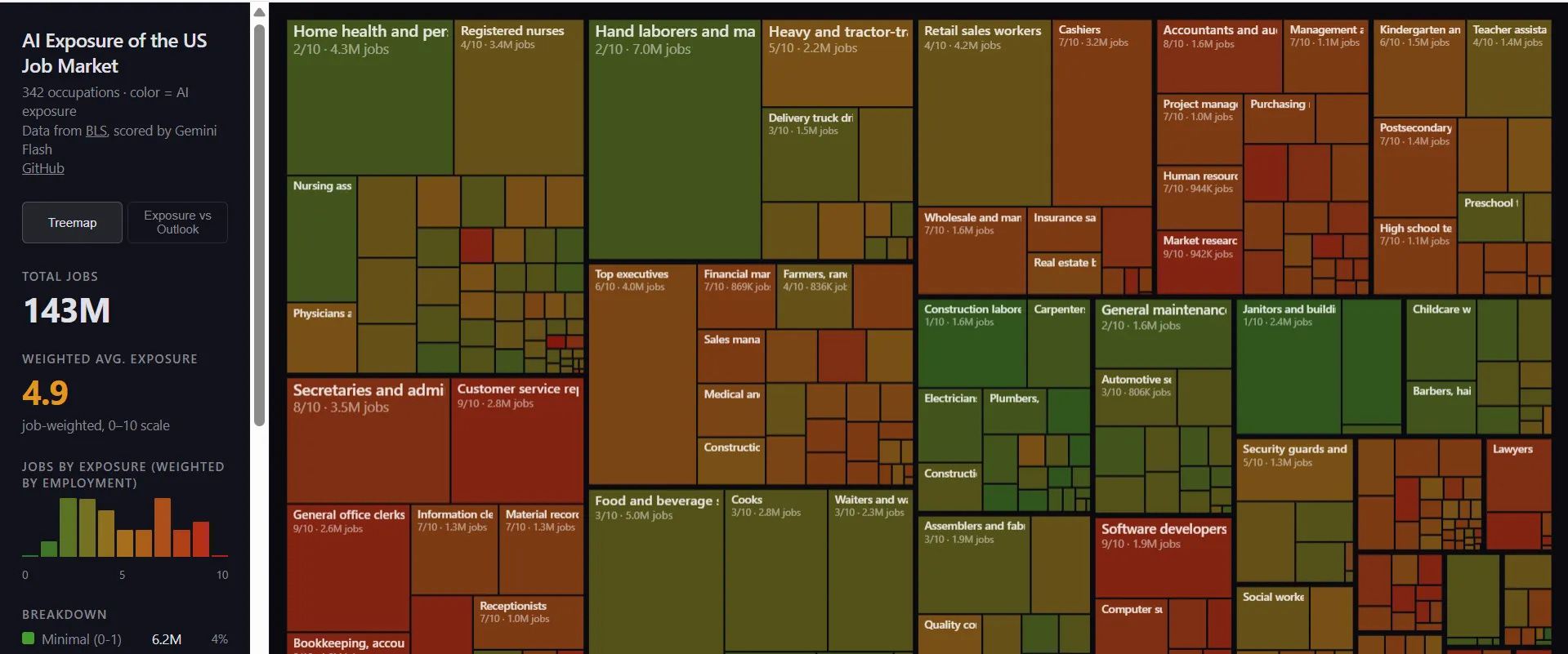
In a world being rapidly automated, people need to rely on adaptability, creativity and resilience. You need to be thinking on a higher order plane about what builds value for people. You need to be flexible and able to pivot without fear of failure, constantly being curious and agile. You have to be the one who is calling the shots and managing the automation, not being replaced by it.
Think about it this way: AI can easily do anything you can program into a formula or decision tree, or anything that is easily repeatable that can be learned. And it does it 100x faster than a human. If your daily work is made up of routines, then it can likely be automated. A radiologist looking at X-rays or MRIs to detect fractures? Automated. A CPA that fills out your tax forms and filings? Automated. A lawyer that reviews contracts, checks for regulatory compliance, and drafts documents? Automated. In a world of gatherers, you need to be a hunter to survive.
How to Become a Hunter
As the child of conservative Taiwanese immigrants, I spent my early life living linearly. I jumped through all the hoops of Ivy League college, big name consulting firm, top business school, and numerous fancy corporate jobs. My identity was completely tied to my resume and I was terrified of leaving that secure path. I was afraid of my parents disapproval and disappointment. I was anxious about being judged by friends and even strangers. I cared so much about how others viewed me and my success. When I finally decided to leave that path and start my own company, I realized how little all of that mattered. I was so fulfilled by being my own boss and doing what I wanted to do with my life, that I couldn’t care less what strangers thought of me. And if they were friends who weren’t supportive, I didn’t need them in my life.
That was my first taste of agency and making my own choice, not the choice of my parents or society. Since then, I have continued to make choices that have empowered me to live an exponential life. Choosing to create a community of Asian American founders. Choosing to pool angels to invest over $30 million in 100 companies. Choosing to write an open letter condemning Asian hate crimes and publish it in the Wall Street Journal. Choosing to finance a documentary about Jeremy Lin. Choosing to launch a venture capital fund. Choosing to start Hyphen Nation to publish essays and a podcast to inspire others. I didn’t need permission, I had to make choices.
Every one of these decisions led to an experience with compounding returns that created more opportunities and choices. I didn’t escape my linear life, I just learned how to leverage and compound it into an exponential one with my decisions. This isn’t about leaving your life behind. Nothing you’ve lived is wasted. Your life is a book, and every chapter adds to the last one. This is about proactively investing in the life you’ve built in a way that will hopefully yield compounding returns. Was it easy making these choices or was it a smooth journey along the way? Not at all. But looking back, each of these decisions shaped who I am today and I am grateful for making them.
The founder community gave me access to entrepreneurs and investors for my angel syndicate. Together we’ve invested in multiple billion dollar companies like Gamma, Formation Bio, Persona and Super.com among others. The syndicate I grew, allowed me to instantly recruit hundreds of prominent signatures for my open letter which helped raise millions of dollars. Through this group, I also found fellow financiers to help produce 38 at the Garden which resulted in winning my first Emmy Award. This notoriety has led to speaking opportunities, awards, board positions like the Smithsonian Asian Pacific Center and even being featured in museums like the Museum of Chinese in America and the Milken Center for Advancing the American Dream. All of these amazing experiences coupled with my network have inspired my essays and conversations for the podcast, which has motivated me to write a book. Instead of asking myself why I should do something, I’ve started asking myself why not?
My first-hand advice on shifting from a linear to exponential life:
Take small steps to gain confidence. Define success for yourself. Work backwards and figure out what it takes to get there. When you take small steps towards a dream, it can gradually help to build more self-confidence and belief in what is possible. When I started working on a side project and gradually convinced myself that there was a there there. I only needed a little bit of proof that I could earn a living to quit my job and start my first company. Before I started my first venture capital fund, I invested in numerous startups by syndicating SPVs (special purpose vehicles). Once I realized the value I could bring to the table and started seeing returns, I knew I could build a fund. The only way to find out if a dream is worth chasing is to start working on it. That is by far the hardest part. Whether it’s a book or a business, just get started. Once you’ve achieved your goal, you will realize that you can start taking even bigger swings.
Surround and inspire yourself with other people living exponential lives. It’s a lot easier to take risks and think big when you see others doing it regularly. Watching them not only succeed but fail, and realizing the downside isn’t as bad as you projected it to be. Naysayers and passive people will only project their fears and doubts onto you, and you don’t need that kind of pessimistic energy around you.
Say yes to more opportunities that come your way. Take that coffee meeting when someone reaches out. Join that non-profit advisory board. Go to that conference that you’ve been interested in attending. If there’s one thing I’ve learned, opportunities will come your way when you least expect them, but you have to make room for them. Expand your network because it will open up more doors that weren’t available to you before.
Stop worrying about what others think. We underestimate the power and influence others have over our decisions. Many children of immigrants have spent their lives seeking the approval of their parents, because they feel indebted to them for their sacrifice. If you’ve been on a track your whole life, you are also afraid of judgment by your peers who have been on the same track with you. Only when you free yourself from the burden of others expectations, can you truly start living your life.
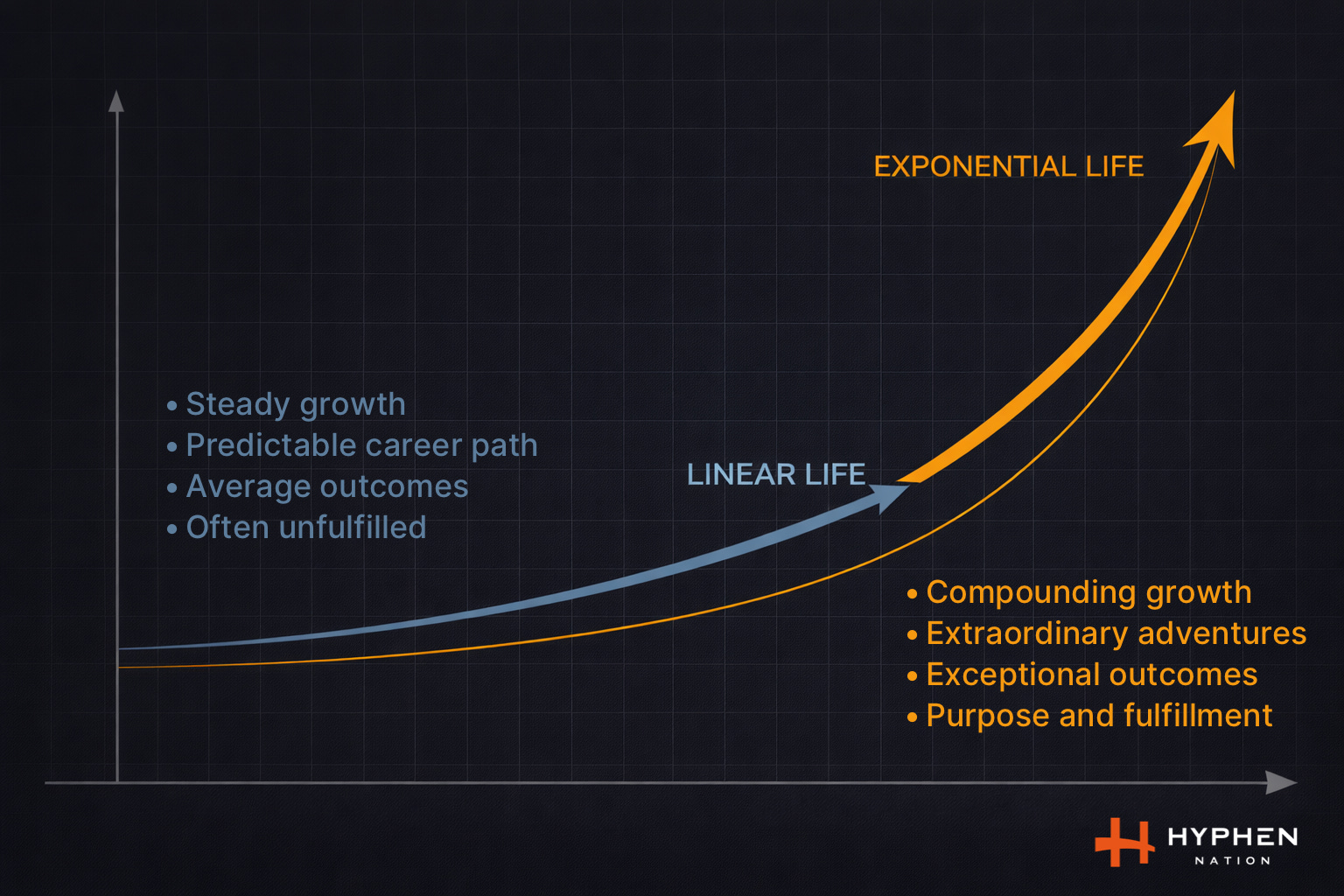
Linear Life = Predictable steps + low variance + capped upside
Exponential Life = Self-directed bets + high variance + uncapped upside
People can become very successful living a linear life, but they might not find fulfillment, especially if that life path was decided for them by someone else. I know plenty of financially successful lawyers and doctors who hate their jobs. Now even those jobs are at risk of becoming made obsolete in the new era of AI technology. An exponential life is about finding success as defined by you, which means it will be inherently purpose-driven and fulfilling.
So to those who have recently been laid off from their jobs: Don’t despair. Reframe it as a blessing that you are free from the hamster wheel. Now you have a head start to figure out how to become a hunter and start living an exponential life. You don’t need to manufacture audacity from scratch, it should come from knowing that your story is worth telling. I realized that I didn’t need to become someone else to start living the exponential life, I just had to give myself permission to be fully me. Everyone has the power to give themselves that permission. You don’t have to follow a script that wasn’t written for you. This week, take one step by doing something not on the script you’ve been given. It’s up to you to start writing your own script.