



Jeremy Lin dreamed of becoming an NBA player since he was young. He played AAU and high school basketball and was named Northern California Division II Player of the Year. He led Palo Alto High School to a 32-1 record and upsetting elite basketball program Mater Dei to win the California Division II State Championship. Despite his impressive basketball resume, he received exactly zero NCAA Division I scholarship offers.
Despite being snubbed by almost all D1 programs, Jeremy played basketball for Harvard University. He led Harvard to a program record 21 wins in his senior year. Jeremy became the first player in Ivy League history to record at least 1,450 points (1,483), 450 rebounds (487), 400 assists (406), and 200 steals (225) in a career. He won Ivy League Player of the Year and was a national finalist for the John R. Wooden Award (nation's top player) and the Bob Cousy Award (nation's top point guard) during his final year at Harvard. Even with all of these accolades, he went undrafted for the 2010 NBA Draft.
Donnie Nelson (son of hall of fame coach Don Nelson) was the only NBA general manager to extend an invitation to Jeremy to play on the Dallas Mavericks' Summer League team. He impressed enough teams that he eventually signed a contract to play with his hometown team, the Golden State Warriors. Jeremy had played against owner Joe Lacob’s son Kirk in AAU games.
Even though he had finally made it to the big leagues, nothing was guaranteed. Every time he came off the bench in front of the hometown Bay Area crowd, the expectations were off the charts, especially from the Asian American fans. Meanwhile, Jeremy was fighting to keep his job every day. On December 11, the Warriors cut him and the Houston Rockets picked him up only to waive him on Christmas Eve just days later. Three days later, the New York Knicks in need of a backup point guard picked him up off the waivers.
Since joining the NBA, Jeremy played from a place of fear and survival. He was playing not to get cut instead of playing his game. When he was thriving in Palo Alto and Cambridge, it was because he played from a place of joy. There was no pressure on him to keep a spot on a roster like there was in the NBA. He had no security, because he could get cut at any moment and his NBA career would be over as soon as it started.
It wasn’t until his back was against the wall, and he had one game left before he would be cut by the Knicks, that the unthinkable happened. Coming off the bench for a decimated team, Jeremy scored 25 points, had 7 assists, 5 rebounds and 2 steals to lead the team to a win against the New Jersey Nets. It was the beginning of one of the most iconic two weeks in NBA history known as “Linsanity” where Jeremy averaged 26 points per game. He was finally playing from a place of joy again.
Jeremy shared that after the first 7 brilliant games of Linsanity, he finally had a bad game against the New Orleans Hornets (I was at that game). He had 9 turnovers. After the game, he got a call from his coach, Mike D’Antoni, and was expecting to be reprimanded for his sloppy play. Instead, Coach D’Antoni said, “Feel free to go get 20 turnovers the next game, because that means you’ll probably 40 assists. As long as you’re going downhill, I’m willing to live with the results. Because every time you go downhill, something good is going to happen and we’re going to win way more games than we’ll lose with you going downhill, so just keep attacking.” Unlike other fear-based coaches, Coach D’Antoni made Jeremy feel like he believed in him, which gave him more self-belief. D’Antoni was learning how to bring out joy in Jeremy.

You are at your best when you are operating from a place of joy. Many people conflate joy with happiness. Happiness is a temporary, fleeting state triggered by external events, achievements, or pleasant moments (such as winning a prize, good weather, or a having a nice meal). Happiness is driven by circumstances and contingent on things going your way.
Joy is defined as a deep feeling or state of great pleasure and contentment. It is a longer-lasting state of being that comes from a sense of inner peace, connection, or a deeper appreciation of life regardless of temporary bumps in the road. Joy is an active choice that comes from within and can persist even during times of grief, stress, or hardship. You can feel deeply sad or in pain and still experience underlying joy. You are also more fearless and bold, when you are not concerned about the downside, because you know that your state of being is not tied to outcomes.
When you are operating out of fear, worrying about making mistakes or doing the wrong thing, you cannot maximize your full potential. When you are constantly worried about survival or job security, you can’t focus on the finish line because you’re too busy looking down at your feet. Those who are raised with a scarcity mindset are programmed to operate from a place of constant fear and anxiety about never having enough and losing what they have. It is impossible reach your full potential and live your best life if you are driven by fear instead of joy.
Scarcity Mindset Meets Hierarchy of Needs
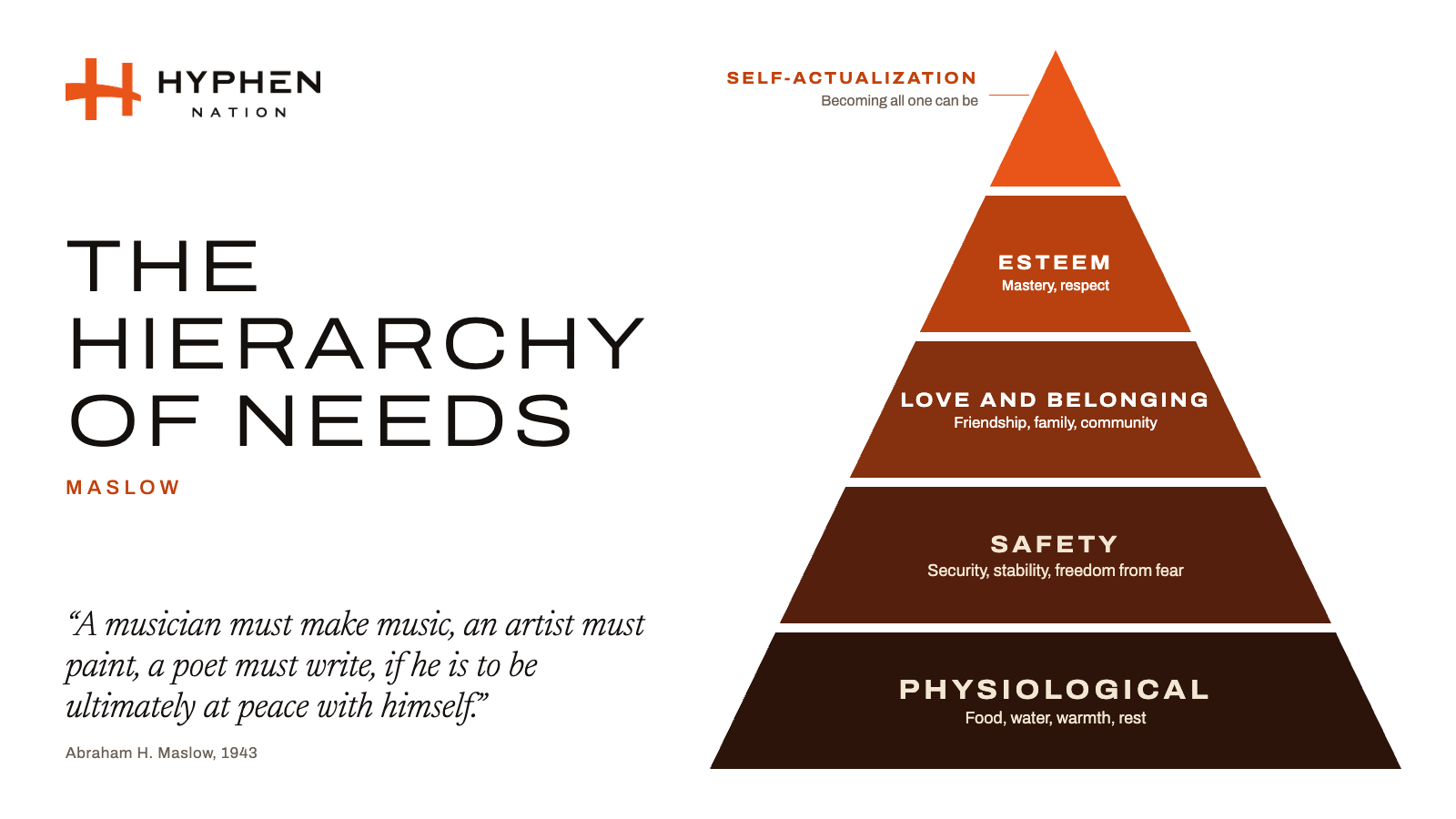
Maslow’s hierarchy of needs pyramid looks like Mount Everest when viewed through the lens of scarcity mindset. I’ve written before about how scarcity mindset can hold you back. When you operate from a place of fear and survival, you are unable to pursue joy and fully achieve self-actualization. You are constantly anchored to the physiological and safety base of the pyramid and unable to focus on higher order needs. If you are too busy clipping coupons or cutting free napkins in half, how will you be able to pursue your big dreams and aspirations? Perception can often outrun reality. So even if you have more than enough saved in the bank, psychologically no amount will fix it.
If you are too busy clipping coupons or cutting free napkins in half, how will you be able to pursue your big dreams and aspirations?
Physiological
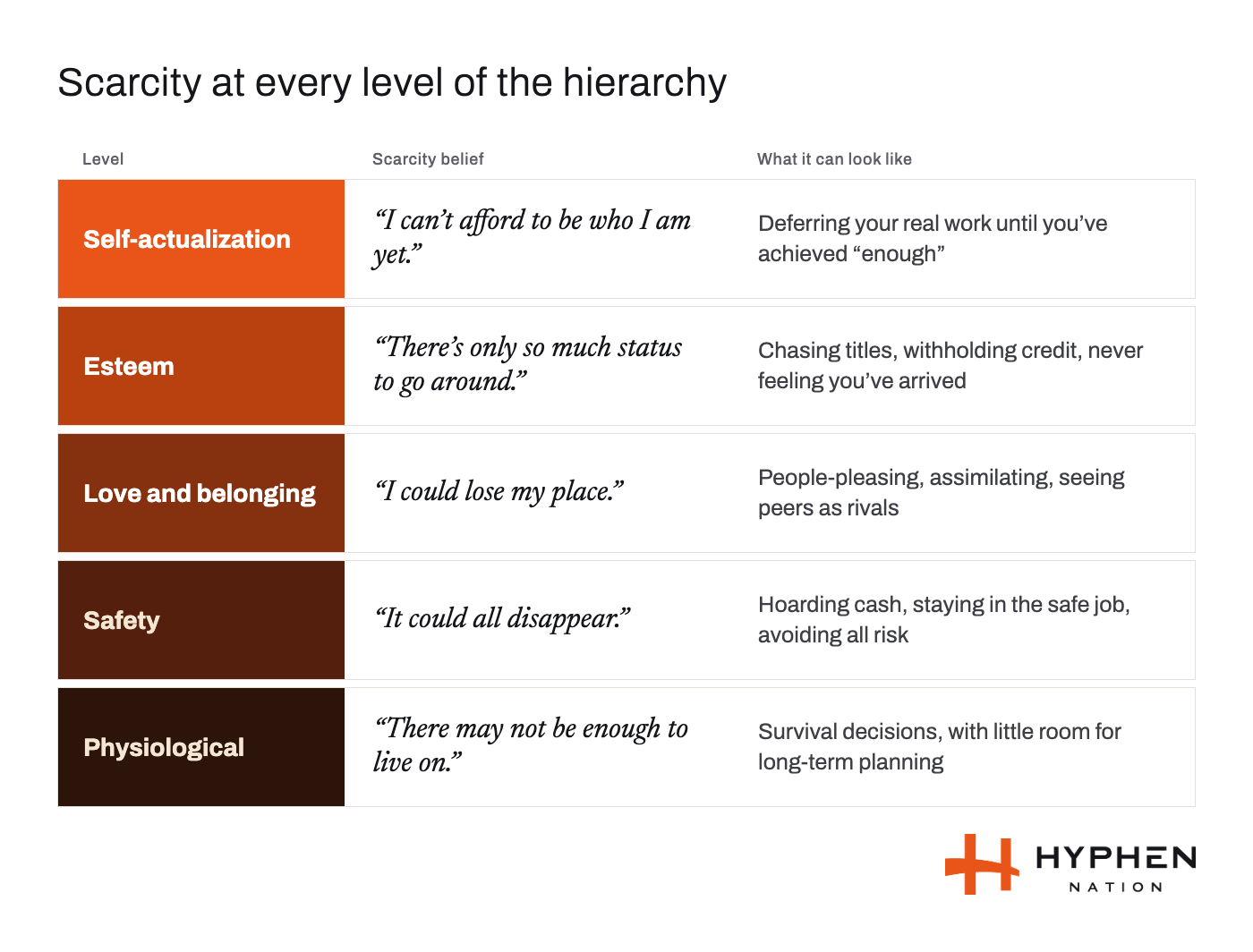
There are those that are extremely successful in their careers, but are still stuck in a scarcity mindset. Even if they have more than enough income and savings to never have to worry about food and shelter again, they have been wired to have anxiety about potentially losing everything. They were raised to believe that your situation can change instantly, because where their parents came from, families went from having generational wealth to having nothing when regimes changed. They will be eternally anxious because they are always planning for the worst-case scenario instead of the best-case one.
Safety
The main reason many children of immigrants pursue safe and reliable careers is for stability and security. People will always need doctors, lawyers, engineers and accountants. Safety means hoarding cash and resources, while avoiding all risk. It means they only invest in the most stable assets like real estate and interest-bearing accounts. They are rarely philanthropic, because they always see themselves as the ones in need. They believe that every day could be a rainy day, so every dollar goes into the rainy day fund. This also makes people stay at dead-end jobs or miserable work situations because they are afraid they won’t be able to find another option.
Love and Belonging
Scarcity makes people believe that the seats at the table are limited, instead of believing you can always pull up another chair. It makes you afraid of not fitting in or being excluded, so you do as you are told. It means you avoid conflict or advocating for yourself because you don’t want to be a burden, so you accommodate everyone else but yourself. This also means being passive aggressive and allowing yourself to be treated poorly because you don’t speak up.
Esteem
When you chase titles or accolades for your sense of achievement, you will never be fulfilled, because you are constantly seeking the approval or acknowledgement of others. There will always be another position or award you can pursue. Scarcity makes you treat everything is a zero-sum game, so you don’t give credit to others or lift others up, because you are worried that there can only be one. Instead you choose to seek glory for yourself.
Self-Actualization
If you are so busy trying to meet the other levels of needs, you will never believe you have enough. Not enough money. Not a big enough title. Not a big enough house. You will rationalize to yourself that you cannot take a risk to start your own company or go pursue that second career you’ve always dreamed of, because you simply can’t “afford” to. Scarcity keeps you stuck in the hamster wheel of the bottom four levels of the hierarchy, because you are too afraid that if you reach for the top, the whole pyramid will collapse beneath you.
I’ve found that many relatively successful professionals have met the lower three or four levels of needs (physiological, safety, belonging and esteem). But self-actualization is rarely a priority. Their careers were always a means to fulfill the rest of the pyramid. They have earned a level of income that provides for their base level needs of food, shelter and safety. They have built families and community to fill their need for love and belonging. And they have climbed the ladder to achieve titles that earn the esteem and respect of others. But for many, that career does not necessarily align with who they were meant to be. They chose a career because it was a reliable path to significant income, not one that based on passion or mission. I’ve met many people who feel this way, because they chose the career path their parents pushed them to take.
A modern criticism of Maslow’s Hierarchy of Needs pyramid is that it is too rigid. In reality, it means that you must take care of your fundamental needs before you can even consider self-actualization. It is possible, however, to experience self-actualization even if some of the other parts of the pyramid are not completely stable. Similarly, reaching self-actualization or moments of self-actualization does not mean that you stop growing or are free of problems. I prefer to think that meeting basic needs is a stable foundation that allows you to safely explore and take bigger swings in life. Having stability allows you to operate from a place of joy rather than fear or survival.
Ask yourself honestly if you have most of your needs met, why you aren’t pursuing the things that bring you joy? What are the stories you are telling yourself about not having enough? Not having enough money. Not having enough friends. Not having enough prestige or a big enough title. If you have enough, do you feel like you are still missing something? Self-actualization doesn’t have to be a luxury. For people who objectively have enough, finding your purpose is a proactive choice. You don’t have to wait until retirement to make that choice. You can bet on yourself now and choose to start that business, write that book, launch that non-profit, or whatever it is that fulfills you.
Find your purpose and you will find your joy.
Are you being held back from being your best self and finding your joy, even though you have more than enough?